Greater Security and Transparency in Production Line Control
FabEagle®LC Release 5.5 delivers enhanced process reliability, flexible workflows, and improved data access for connected production lines
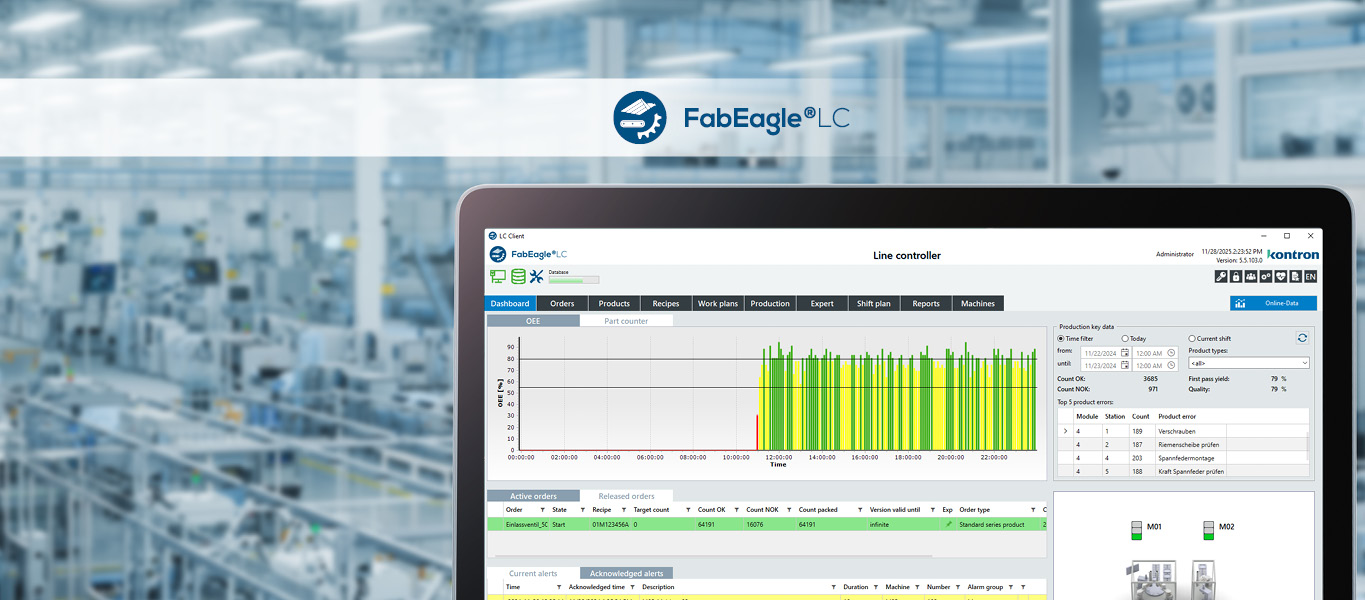
FabEagle®LC Release 5.5 includes numerous functional enhancements focused on secure, reliable, and traceable production processes for automated manufacturing lines.
Advanced carrier management for precise traceability
The new carrier management delivers extended capabilities for tracking products and transport units. Individually configurable carrier types allow complex material flows to be mapped, while product data can be queried directly via the carrier. Support for carrier-in-carrier concepts enables nested transport structures – a key advantage for production environments with high product variability or complex line architectures.
Flexible workflow management and machine visualization
Workflow management has been significantly enhanced regarding flexibility. Individual process steps can now be added, deleted, or rearranged without having to recreate entire workflows. In addition, the updated web-based Andon board provides a clear, real-time overview of relevant machine key figures. Production data can be displayed mobile or browser-based, either for entire production or for defined machine groups.
CRA-compliant security measures
In the new version, component libraries have been updated to improve performance and system stability. A newly integrated Software Bill of Materials (SBOM) provides full transparency across all software components in use. This strengthens the IT security architecture in line with current cybersecurity standards such as the Cyber Resilience Act (CRA).
Modernized interfaces and improved data access for semiconductor manufacturing
The SECS/GEM data interface has been fully migrated to the .NET platform, resulting in improved performance, maintainability, and integration into existing IT and OT environments in semiconductor backend production. In addition, raw data can now be accessed directly from the archive database via the line controller client.
Extended diagnostic functions in the TIA Portal
The Kontron AIS PLC interface block for the TIA Portal (from TIA version 19) has been enhanced with comprehensive diagnostic capabilities. This provides machine builders and maintenance teams with detailed insights into block status, enabling faster fault identification and resolution – and ultimately increasing equipment availability.